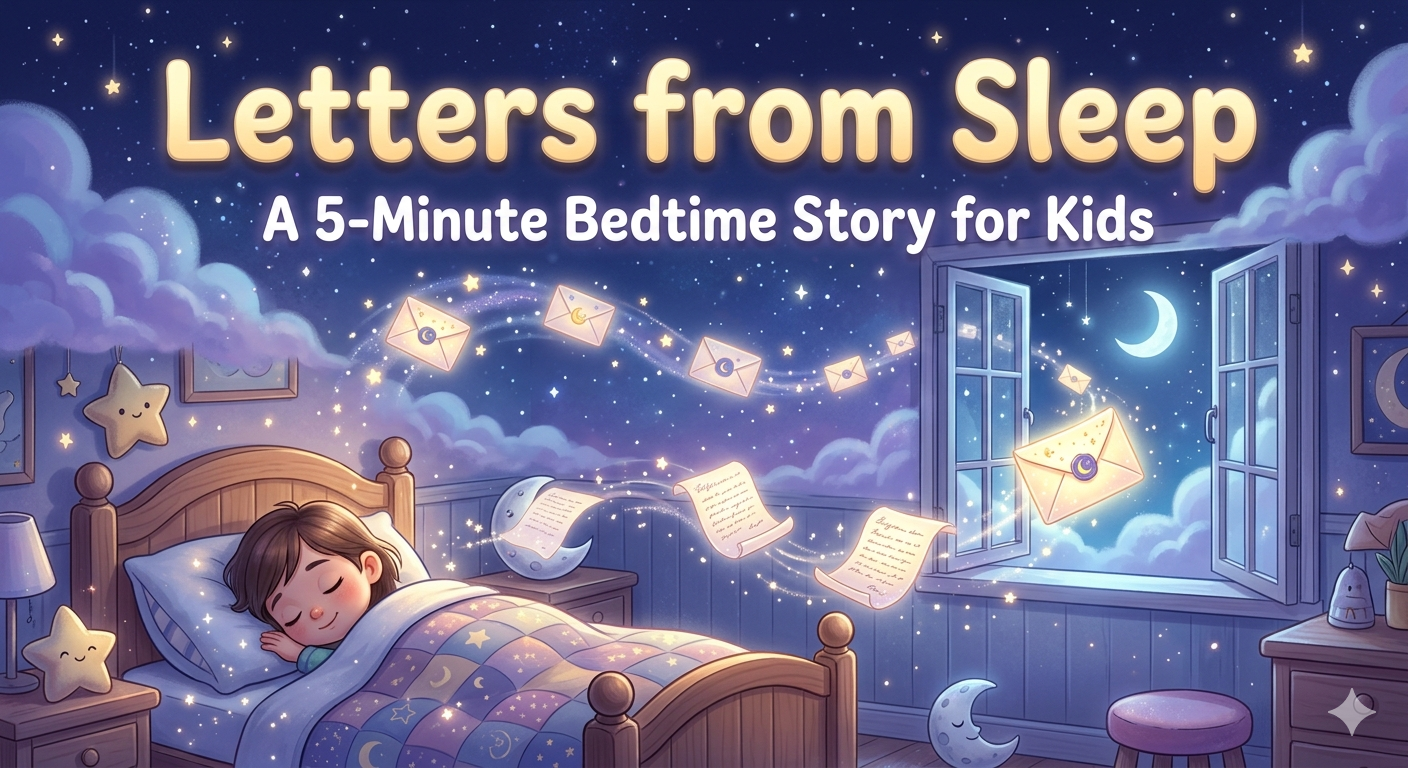
Letters from
Sleep
The night Sleep started sending postcards to the one child in the world who absolutely refused to let it in.
“Sleep is not something that happens to you — it is something you choose to let in. And when you finally do, it has been waiting patiently all along.”
★
BEDTIME
Bedtime Stories
Original Series
There was once a child named Juno who was famously, legendarily, spectacularly bad at going to sleep. Not because she wasn’t tired — she was always tired. But going to sleep felt like stopping, and stopping felt like giving up, and giving up felt wrong even when there was nothing left to give up on. So she lay awake, night after night, full of a restless laughter that had nowhere to go, staring at the ceiling and waiting for something she couldn’t name. Until the postcards started arriving.
The Bed She’s Not
Sleeping In
Third House
Maple Street
At Dusk
Nightly
Thank you for your letter. I am not asleep right now because I am thinking about something very important. What I am thinking about is a secret. Also I am not sure flying and cake sounds that great because I can already imagine flying and cake during the day when I’m awake which is much better.
Please try again tomorrow. I may be less busy.
Sleep, who had been sending letters to difficult children since before anyone thought to collect goodnights, was not discouraged. Sleep was very patient. Sleep had time.
(Still Awake)
Same Bed
Maple Street
Attempt
Patient
The important thing was NOT solved and it got bigger actually. It is about whether jellyfish can feel happy. I looked it up and the answer is complicated and now I’m thinking about complicated things which means I definitely can’t sleep.
The chocolate cake part is interesting though. What kind?
Who Is Ready
When She Is
Ready
Delivery
With Love
Juno put down her torch. She thought about the jellyfish, who were probably floating somewhere in the dark right now, feeling whatever it is jellyfish feel, unbothered by Juno thinking about them. She thought about the victoria sponge. She thought about all the things that waited. Then she rolled over, pulled the blanket to her chin, and — just this once — went to the door herself.
Sleep was there. It always had been. It came in quietly, the way things do when they have been invited at last, and it was even better than described — the cake and the swimming and the colours that had no daytime names. Juno thought about jellyfish the whole time, which turned out to be perfectly allowed.
She wrote back in the morning. The letter said: “You were right about the jam.”
What is this 5 minute bedtime story about?
This story is told entirely through postcards and letters exchanged between Sleep (personified as a patient, wry presence) and Juno, a famously stubborn child who refuses to fall asleep. Sleep writes three increasingly charming postcards; Juno writes back in crayon with increasingly reasonable objections. The third postcard finally reaches her — and Juno chooses, on her own terms, to let Sleep in. It is a funny, tender, deeply original story about the nightly negotiation between children and bedtime.
What age is this short bedtime story best for?
This 5 minute bedtime story is ideal for children aged 4 to 8 — especially those who are difficult to settle at bedtime. Juno’s crayon replies are immediately recognisable to any child who has ever argued with bedtime, and Sleep’s patient, gentle responses model the kind of calm that helps children feel heard rather than told off. Reading this story itself becomes a version of letting Sleep in.
What is the moral lesson of this unique bedtime story?
The moral is: sleep is not something that happens to you — it is something you choose to let in, and when you finally do, it has been waiting patiently all along. The story reframes sleep from something imposed on children to something generous that arrives by invitation. Juno’s eventual choice to “go to the door herself” is a small act of agency that resonates deeply — she chooses sleep, rather than being told to sleep.
How long does this story take to read aloud at bedtime?
At a warm, conversational bedtime pace, this story takes 4 to 5 minutes. The epistolary format — reading postcards and letters — naturally encourages a slightly slower, more deliberate pace, which helps settle a child’s breathing. The final narrator section is intentionally quiet and soft, ending on a note perfectly suited to closing eyes.
Is this an original story not published anywhere else?
“Letters from Sleep” is a completely original story — the concept of Sleep as a letter-writing character who sends increasingly charming postcards to one stubborn child, and receives crayon replies in return, does not exist in any book, blog, or story website anywhere online. Every story in our 5 Minute Bedtime Stories for Kids series is 100% unique and published here for the first time.